Missiles from the Heavens
By Lloyd Edwards
Wednesday, 3rd December 2025What an amazing few cruises we have had lately. It is difficult to judge, but there must have been around 50 000 Cape gannets feeding in Algoa Bay on our last two cruises. Add to these 3 000 Common dolphins, 20 Bryde’s whales, around 10 000 Sooty shearwaters and the odd Cape fur seal. That was besides the sharks and game fish lurking beneath the surface that we could not see.
Here we concentrate on the death-defying Cape Gannets. How can they hit the water at speeds of up to 100km/h without doing any damage? The odd thing is that they could hit at speeds of up to 288km/h without harming themselves. How is this possible?
Well, good old evolution has allowed their bodies to adapt to this kind of punishment.
Their bodies are perfectly streamlined. While plunge-diving and just about to hit the water, they tuck their wings in and extend their neck, reinforced skull and bill in a straight line. The bill is sharply pointed and the head has a greater diameter than the neck. This forms an air cavity around the neck until the reinforced breastbone hits the water.
The initial impact is absorbed by subcutaneous air sacs, which are an extension of the respiratory system. These “air bags” are located just beneath the skin on their faces, necks and chests. They lack nostrils on the front of their bills, which prevents water from entering the nasal passages. Instead, they are located at the base and covered by a hard tissue.
They have strong muscles in their necks, which contract just before impact and locks the vertebrae in place in a straight line. This prevents the neck from bending and fracturing on impact. The neck length is important and the diving speed is limited to ensure its safety. On fast dives, they hit the water at about 80 degrees, which is in line with the body structure.
The eyes are forward facing, which allows binocular vision. This allows them to judge distance perfectly and locate their prey exceptionally well, even from a great height. Their eyes have adapted to block out ultraviolet light reflection that distorts the position of the moving prey. They have also learned to compensate for refraction caused by the water surface. This makes the prey look like it is in a different position. Even more amazing, is that they can change the shape of the lens once they are underwater and thus focus on the prey. Cetaceans do the exact opposite, and change the shape of the lens once they pop their heads out of the water.
The initial dive can take them down to 10 metres. They can slow their descent when reaching prey by flaring their wings and feet. By using their large webbed feet and partially closed wings, they can propel themselves all the way down to 22 metres.
Compared to other seabirds, they have an energy expensive flight. They compensate for this by flying in a formation, that allows them to slipstream in the one in front. They fly close to the water and get some lift from the waves.
They increase their chances of finding prey by watching the direction from which other birds return. They also follow predators and particularly the Long-beaked common dolphins. When feeding chicks, adults can forage up to 300km from their breeding islands. If not, they may stay overnight at sea, digested their food and huddled together for safety.
The most dangerous part of plunge-diving is hitting each other or other predators. Although not always fatal, during the sardine run, 1% of dives end in a collision. The juveniles are particularly vulnerable, especially while engaging in deep dives. During shallow dives they will hit the water at a low angle but still ensure that their bodies are perfectly straight.
There are close to a quarter of a million gannets at Bird Island at the eastern end of Algoa Bay, making this the largest gannetry on the planet. Although it is still too early to tell, it looks like the pelagic fishing ban around our breeding islands is having an effect. We have never seen so much bird activity on the go, since it came into effect earlier this year.
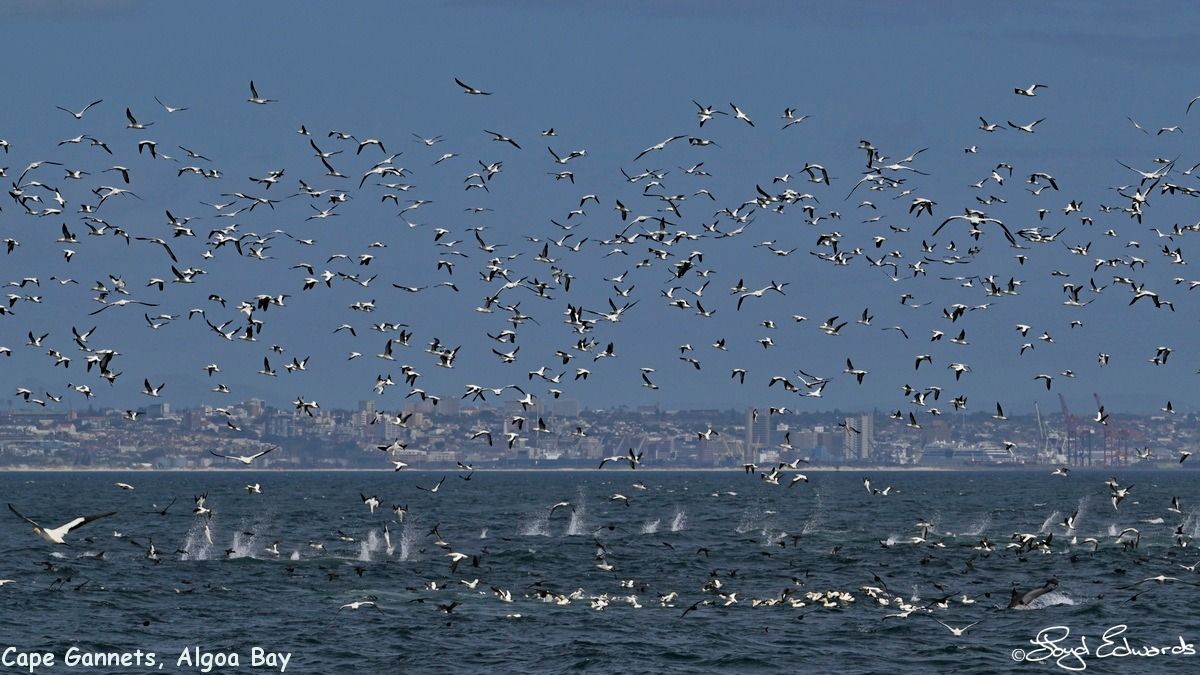
Taken with a Nikon Z9 mirrorless, ISO 280, 200mm zoom (70 - 200 f2.8 lens), f/10 and 1/1600th second. The small aperture keeps the city in focus.
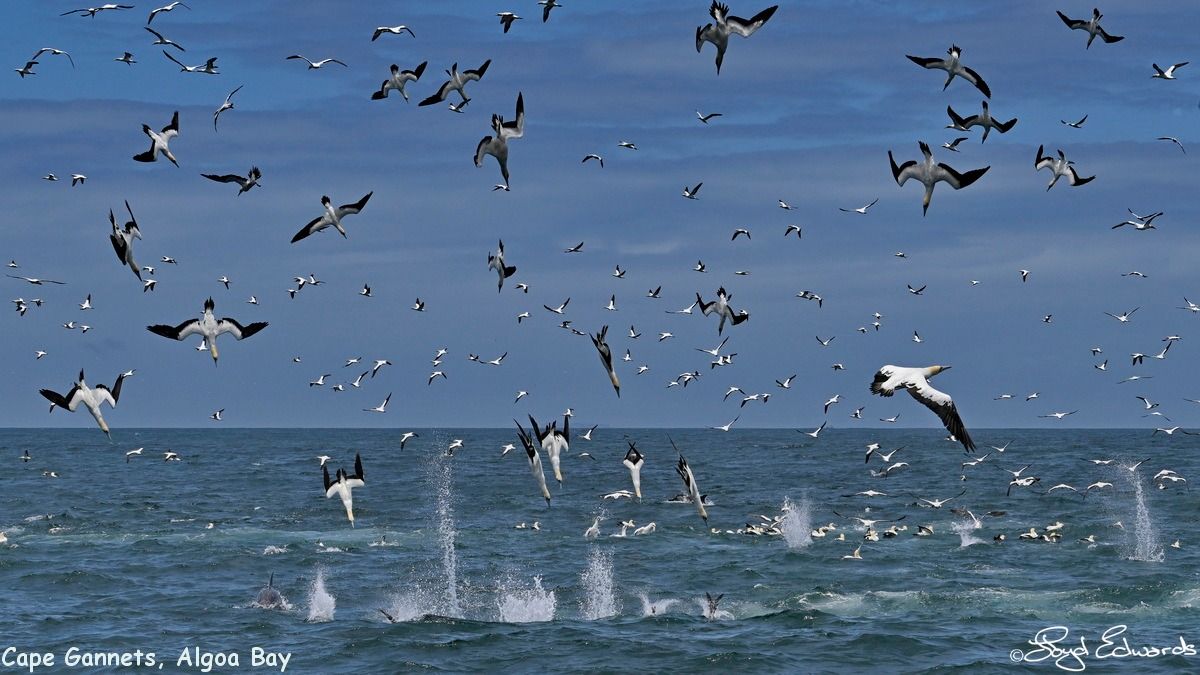
These are dives from around 40 metres, as the prey is deep. With so much action, collisions become an issue and must be avoided at all costs.
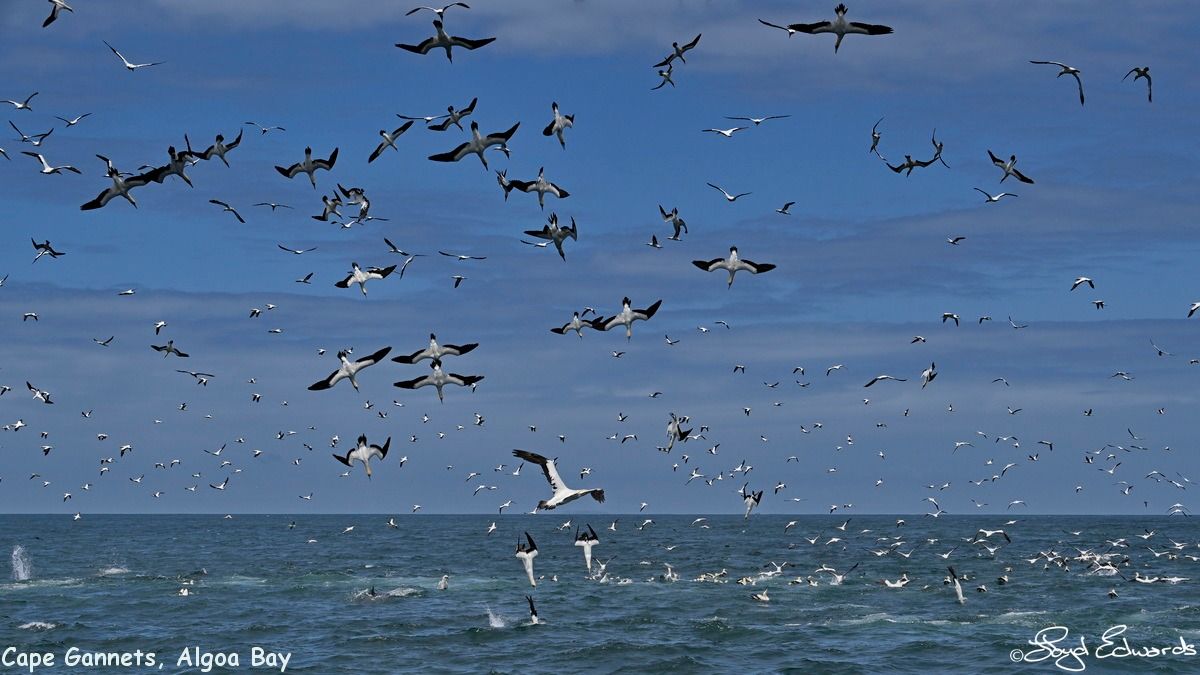
We stayed on the moving bait balls for four hours . . . and never made it to St Croix Island to see the penguins. We were just about to have a vote if we should stay with the action or go and see the penguins . . . and the next lot of action started! Forgone conclusion!
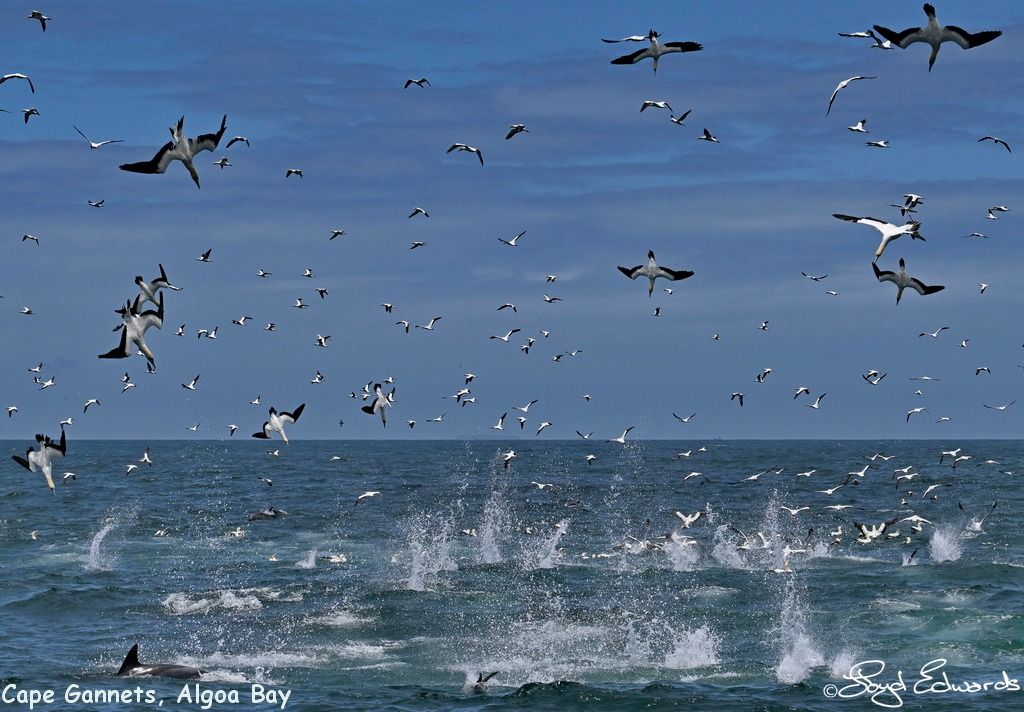
This is when they start making the warra warra warra sounds, warning the others to get out of the way!
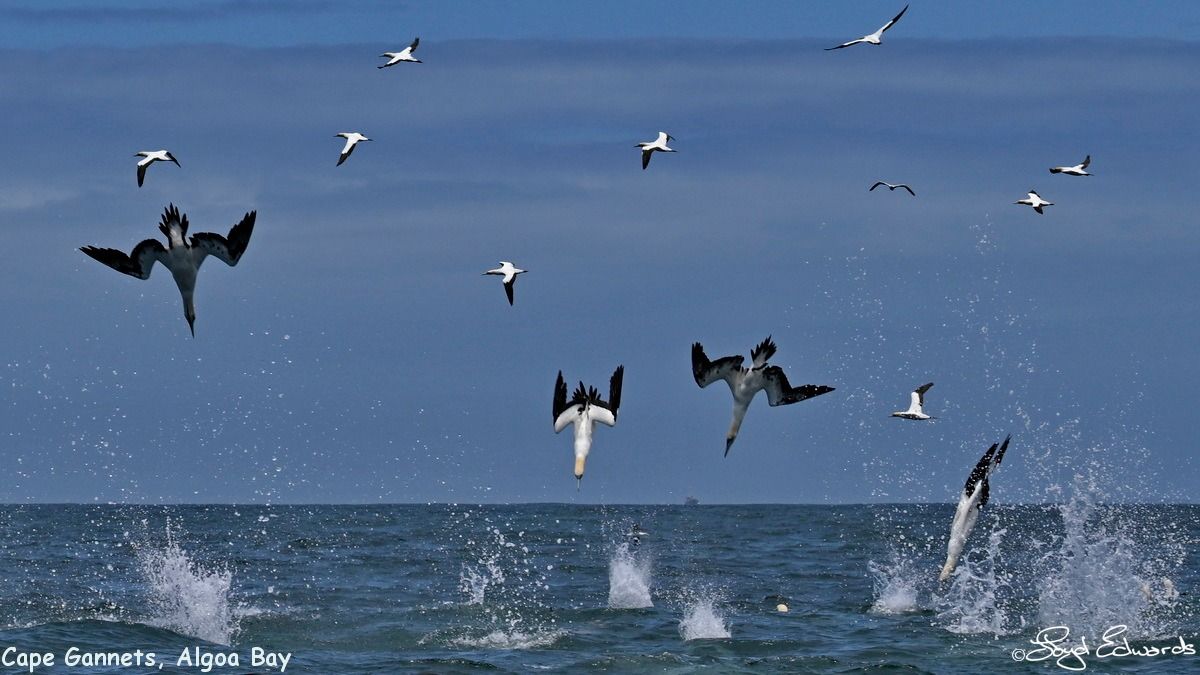
The top three are busy getting into the right shape. The neck muscles are contracting to hold the neck straight and the vertebrae in place.
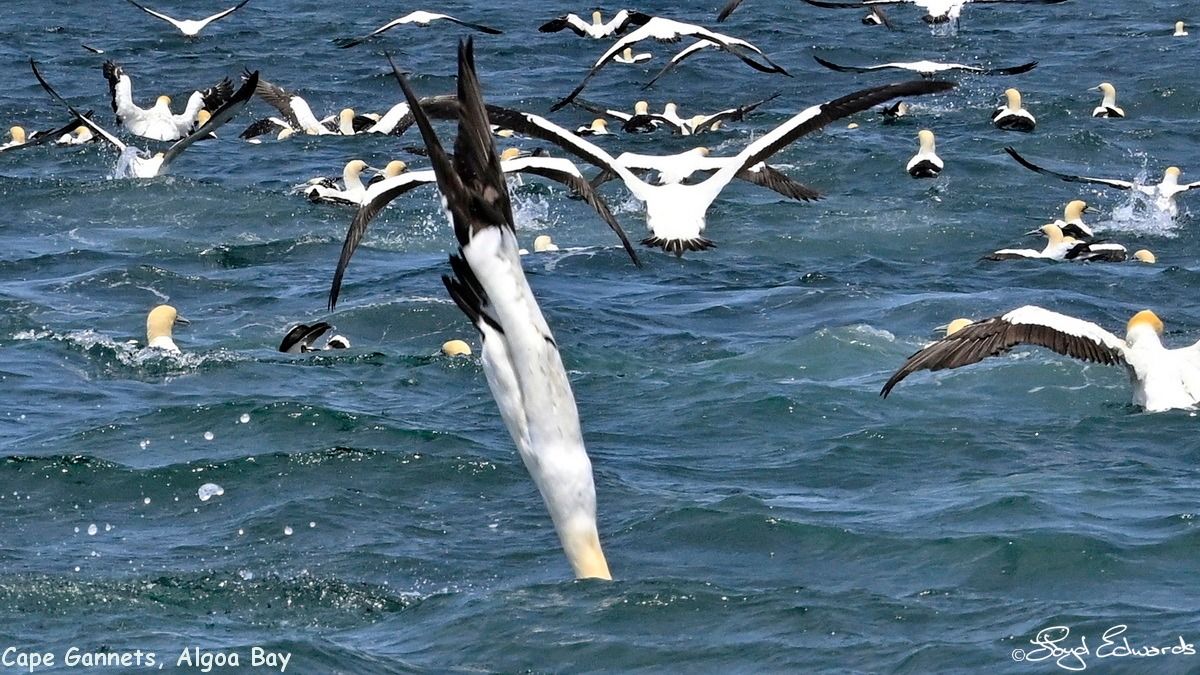
Perfect streamlined shape and no splash as the head enters the water at an 80 degree angle. The head is thicker than the neck so will create an air cavity around the neck. Air bags under the skin help absorb the impact.