RARE VISITOR TO ALGOA BAY
By Lloyd Edwards
Thursday, 27th June 2013On a beautiful winter morning on the 12th June, 2013 I was doing my usual St Croix Island penguin cruise while admiring the spectacular array of marine life that Algoa Bay has to offer. The bay was still full of sardines and anchovies being pursued by a whole host of predators... The sardine run was far from over. We had already observed 300 bottlenose dolphins around the islands and then proceeded to get up close to the penguins on St Croix. It was business as usual as they were slipping and sliding into the water off to their daily foraging trips. All of a sudden one of the tourists shouted seal! Oh no I thought; let’s hope the Cape fur seals are not on the island again messing with the endangered African penguins that were already having such a hard time. We have lost 70% of the population during the last seven years, leaving a mere 22 000 of them on the island.
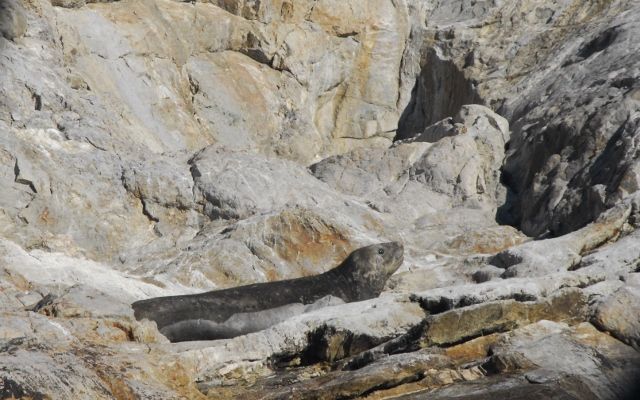
I eased the boat closer and to my astonishment saw what looked like two large seals lying snout to flipper. This eventually turned out to be a 3 metre long elephant seal, an adult male (bull). You can see that this animal is a bull, not so much by his nose but by his body shape. The head of a bull is much larger in proportion to the rest of its body than is the case for a cow. Also, bulls have far more weight around the shoulders, whereas cows carry more around their abdomen. While this one’s proboscis is not that pronounced, it becomes inflated during the breeding season giving it that characteristic “elephant seal” look. This is where the common name originates as it resembles an elephant’s trunk. It has two functions. The first is to produce an extremely load roaring noise, especially during the mating season. The other is to reabsorb exhaled water with the help of numerous cavities throughout the organ. This is extremely important during mating season when they cannot go to sea to feed and thus need to conserve as much water as possible.
There are two types of elephant seal found globally, one in the Northern and the other in the Southern Hemisphere. We have on average, one Southern elephant seal stranding a year along the South African coastline, with about one every five years coming ashore in Algoa Bay. This is a first for me in my 20 years of taking tourists out to St Croix Island. The closest breeding colony of elephant seals is located on the Prince Edwards Islands (which include Marion Island) in the sub-Antarctic about 2000km south of us. Another Southern elephant seal yearling tagged in Southern Georgia in 1989 swam almost 5000km to our coastline.
The females usually haul out for their annual moult from October to December while the males do the same from January until March. During the moult the seal’s hair and skin comes off in large patches and has to regrow. After this they spend the next eight months at sea fattening up for the coming breeding season. They are extremely apt divers and some can stay underwater for two hours and reach depths of 1 500 metres. The recorded maximum depth for an individual was 1850 metres! This is the greatest depth attained by any mammal other than a cetacean (whales, dolphins and porpoises). Sperm whales have been recorded at 3 000 metres and many of the beaked whales can attain similar depths to the elephant seal.
The females, unlike the males, vary their feeding routes and may wander off to different places in search of prey. Species targeted include octopus and squid as well as fish and small sharks, rays and skates. Some of them have even been observed eating smaller species of penguins. This is probably why the African penguins in the photograph are keeping a watchful eye on the 900kg beast which has taken up residence on their breeding island. For good reason, as an adult male elephant seal was observed killing 88 breeding Magellanic penguins in Argentina over a two year period.
Not only are penguins at risk but juvenile seals as well. During November 2012 another adult male elephant seal was observed at Robberg Peninsula, Plettenberg Bay with a Cape fur seal pup in its mouth. The pup was still alive and the elephant seal repeatedly whacked it on the surface of the water to soften it up before swallowing it whole. This is pretty much the same behaviour we have observed in Cape fur seals while breaking up their favourite prey in Algoa Bay... electric rays.
Scientists are still not sure what causes them to stray so far from their home grounds. It could be due to ocean currents or it is possibly just in their nature to explore new grounds. Some individuals have been spotted coming ashore in the same area on the South African coast for three years in a row. I have informed the two seal scientists in the area and they are thrilled at the news. We saw the seal again the following day (13th June) lying in exactly the same place and in the same position, it must have been exhausted. Our next visit to the island was on the 17th June and to our great disappointment it left us and presumably Algoa Bay. We will be keeping a sharp lookout next year as they are known to revisit known sites.

Lloyd Edwards, Seaview, Port Elizabeth, 27th June, 2013.